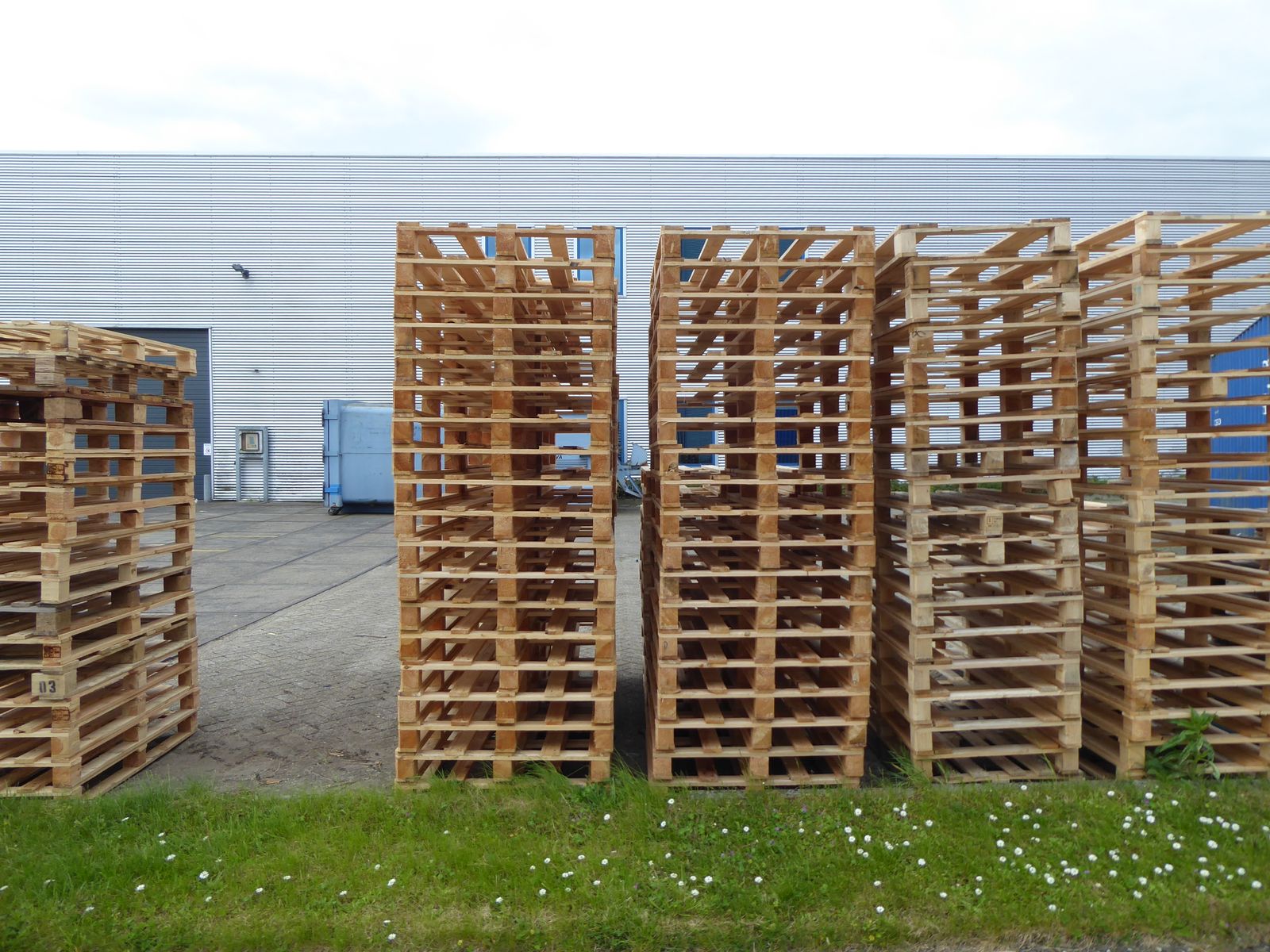
If you run a warehouse, distribution center, or shipping operation in Florida, you probably handle 48x40 pallets every single day. The 48x40 footprint is the most widely used pallet size in North American logistics, and for most businesses it is the default choice for receiving, storing, and shipping freight. But despite how common these pallets are, many buyers do not fully understand what makes a 48x40 pallet "standard," what GMA actually means, or when a different pallet type might serve their operation better.
This guide explains why 48x40 became the dominant pallet size, what people generally mean when they refer to a standard pallet, and how to choose between new, used, and recycled 48x40 pallets for your operation in Central Florida.
Why 48x40 Became the Standard Pallet Size
The 48x40 pallet did not become the industry standard by accident. Its dimensions are the result of practical logistics engineering that optimized for trailer loading, warehouse racking, and forklift handling all at once.
A 48x40 pallet fits efficiently inside a standard 53-foot dry van trailer. When loaded side by side, you can fit two pallets side by side across the trailer width, and a full double-stacked load can accommodate 26 to 30 pallets depending on trailer configuration and load height. That loading efficiency made the 48x40 footprint attractive to grocery distributors, retailers, and freight carriers, and over time it became the size that the entire supply chain standardized around.
The 48x40 dimension also works well with standard warehouse racking. Most selective pallet racking is designed to accommodate 48-inch depth beams, which means a 48x40 pallet sits cleanly on the rack without overhang or wasted space. Forklifts and pallet jacks are built around this footprint, making handling predictable and efficient.
What People Mean by "Standard Pallet"
When someone in U.S. logistics refers to a "standard pallet," they are almost always talking about a 48x40 wood pallet. It is the size you will find at most distribution centers, manufacturing facilities, and loading docks across Florida and the rest of the country.
However, "standard" is a general industry term, not a formal specification. A 48x40 pallet from one supplier may use different lumber, have a different number of stringers or deck boards, or carry a different load rating than a 48x40 pallet from another supplier. The dimensions are standard, but the construction is not. That distinction matters when you are sourcing pallets for a specific application.
48x40 Pallets and GMA-Style Construction
The term "GMA pallet" comes from the Grocery Manufacturers Association, the industry group whose specifications helped establish the 48x40 footprint as the default for grocery and retail distribution. A GMA-style pallet is typically a 48x40 stringer pallet built with specific board counts, stringer dimensions, and construction patterns that align with grocery supply chain expectations.
It is important to understand that "GMA-style" describes a general construction pattern, not an official certification. There is no governing body that inspects and certifies individual pallets as "GMA-certified." A 48x40 pallet built to GMA-style specifications will generally have the same overall dimensions and construction approach, but the lumber grade, board thickness, and fastener type can vary between manufacturers.
This is why specifying what you actually need — dimensions, load capacity, lumber type, and condition — is more useful than simply asking a supplier for "a standard pallet" or "a GMA pallet." Two 48x40 GMA-style pallets from different sources can perform very differently under load.
Industries and Applications That Rely on 48x40 Pallets
The 48x40 footprint is used across virtually every industry that moves freight. Some of the most common applications include:
- Grocery and food distribution — 48x40 is the default size for grocery supply chains, retail distribution, and food service logistics
- Retail and consumer goods — big-box retailers, e-commerce fulfillment, and general merchandise distribution
- Manufacturing — moving finished goods from production lines to storage or shipping
- Beverage distribution — breweries, bottlers, and beverage distributors rely on 48x40 for palletized loads
- Third-party logistics (3PL) — 3PL warehouses and cross-dock operations handle 48x40 pallets from multiple customers
- Construction and building supply — moving packaged building materials, fixtures, and supplies
- Agriculture — Florida agricultural operations use 48x40 pallets for produce, fertilizer, and feed
If your operation interfaces with any of these supply chains, 48x40 pallets are likely the path of least resistance for compatibility with your partners' racking, trailers, and handling equipment.
New vs. Used vs. Recycled 48x40 Pallets
Once you have settled on the 48x40 footprint, the next decision is pallet condition. The three primary options — new, used, and recycled — serve different operational needs and budgets.
New 48x40 Pallets
New 48x40 pallets are built from fresh-milled lumber and have never been in service. They offer the most consistent dimensions, the cleanest appearance, and the most predictable load ratings. New pallets are the right choice when your shipments are customer-facing, when you need uniform dimensions for automated handling systems, or when your operation has strict pallet specifications that used or recycled stock cannot reliably meet.
Used 48x40 Pallets
Used 48x40 pallets are pallets that have been previously in service and are inspected for condition but not repaired. They typically cost significantly less than new pallets and are practical for one-way shipping, temporary staging, and operations where appearance is secondary to function. Used pallets are not the best fit for customer-facing shipments or automated fulfillment lines where dimensional consistency is critical.
Recycled 48x40 Pallets
Recycled 48x40 pallets are previously used pallets that have been actively reconditioned — damaged boards replaced, stringers repaired, and structural connections re-nailed — then graded by quality (typically A-grade or B-grade). They offer a middle ground: more consistent and reliable than used pallets, but more affordable than new. For many Florida warehouses and distribution centers running high daily pallet volume, recycled 48x40 pallets provide the best balance of cost and performance.
Need 48x40 Pallets in Central Florida?
W W Pallets supplies new, used, and recycled 48x40 pallets from our Plant City yard, with delivery throughout Tampa, Lakeland, Hillsborough County, and the I-4 corridor. Call (813) 707-8474 or request a quote for pricing and availability.
Why Pallet Condition and Construction Matter
Even within the 48x40 footprint, pallet quality varies significantly. A 48x40 pallet is not just a 48x40 pallet — the construction details determine whether it performs reliably in your operation.
Key factors to consider include:
- Stringer vs. block construction — stringer pallets have parallel wood runners along the length; block pallets use solid wood blocks at the corners and center for four-way forklift entry
- Lumber type — southern yellow pine, hardwood, or mixed lumber affects weight, stiffness, and load capacity
- Board thickness and count — thicker top and bottom deck boards handle heavier loads and resist impact damage
- Load rating — dynamic (in transit), static (warehouse storage), and racking load capacities differ and should match your application
- Dimensional consistency — pallets that vary by even half an inch can cause problems in automated handling systems and tight racking
For operations running high volume through automated systems or racking, consistency is often more important than cost. A pallet that is slightly too tall, too short, or too wide can jam a conveyor, fail to seat properly in rack, or create an unsafe handling situation.
Specify What You Actually Need
One of the most common mistakes pallet buyers make is asking a supplier for "standard pallets" without specifying anything beyond the size. That leaves the supplier guessing about your actual requirements, and you may end up with pallets that do not fit your operation.
When ordering, be prepared to specify:
- Exact dimensions (48x40 is the starting point, but confirm the height)
- Load capacity requirements (dynamic, static, and racking if applicable)
- Condition preference (new, used, or recycled)
- Construction type (stringer or block, if it matters for your operation)
- Volume and delivery schedule (single order vs. recurring supply)
- Whether heat treatment is required for export shipping
A supplier that understands these requirements can match you with the right pallet. One that simply says "yes, we have standard pallets" without asking follow-up questions may not be set up to support a commercial operation.
When Custom Pallets Make More Sense
The 48x40 footprint works for most general freight, but it is not the right size for every product. If your goods have unusual dimensions, concentrated heavy loads, or specific handling requirements, a standard 48x40 pallet may cause product overhang, wasted space, or unstable loads.
In those cases, custom pallets built to your exact specifications solve problems that no standard-size pallet can address. Custom pallets can be designed for specific product footprints, load weights, racking dimensions, or shipping configurations. Many operations use a mix — 48x40 pallets for general freight and custom pallets for specialized products.
When Heat Treatment and ISPM-15 Become Relevant
If your business ships internationally — through Port Tampa Bay or any export channel — standard 48x40 pallets need to meet ISPM-15 requirements. ISPM-15 is the international standard for wood packaging materials, and it requires pallets to be heat-treated to eliminate pests and prevent the spread of wood-borne insects.
Heat-treated 48x40 pallets are stamped with an ISPM-15 compliance mark and are required for export shipments. Used and recycled pallets are generally not recommended for export unless they carry a valid ISPM-15 stamp. If your operation includes any international shipping, make sure your supplier can provide heat-treated pallets that are properly stamped and documented.
Why Local Sourcing Matters for 48x40 Pallet Supply
For Florida businesses that go through 48x40 pallets in volume, the supplier's location matters more than many buyers realize. A pallet supplier based in your region can deliver faster, keep freight costs lower, and respond more quickly when demand changes.
W W Pallets is based in Plant City, directly on the I-4 corridor. From there, we deliver 48x40 pallets throughout Tampa, Lakeland, and the broader Central Florida region. That proximity means shorter lead times, lower delivery costs, and the ability to set up recurring delivery schedules for operations that need consistent supply.
For warehouses and distribution centers that depend on steady pallet availability, a local supplier that understands your volume patterns and can deliver on a schedule is far more valuable than a distant source with a lower per-pallet price but unreliable delivery.
Choosing the Right 48x40 Pallets for Your Operation
The 48x40 pallet is the right starting point for most Florida warehouses, distributors, and manufacturers. But the right 48x40 pallet for your operation depends on your loads, your handling equipment, your shipping partners, and your budget.
For customer-facing shipments and automated systems, new 48x40 pallets provide the consistency and appearance you need. For one-way shipping and internal movement, used pallets keep costs down. For high-volume warehouse and distribution operations, recycled pallets offer the best balance of cost and reliability. And for specialized products or export shipping, custom or heat-treated pallets may be the better choice.
The key is to work with a supplier that offers all of these options, understands your operational requirements, and can deliver consistently. If your business needs 48x40 pallets in Central Florida, W W Pallets can help. Call (813) 707-8474 or request a quote online with your pallet type, quantity, and delivery location, and we will send clear pricing with no hidden fees.