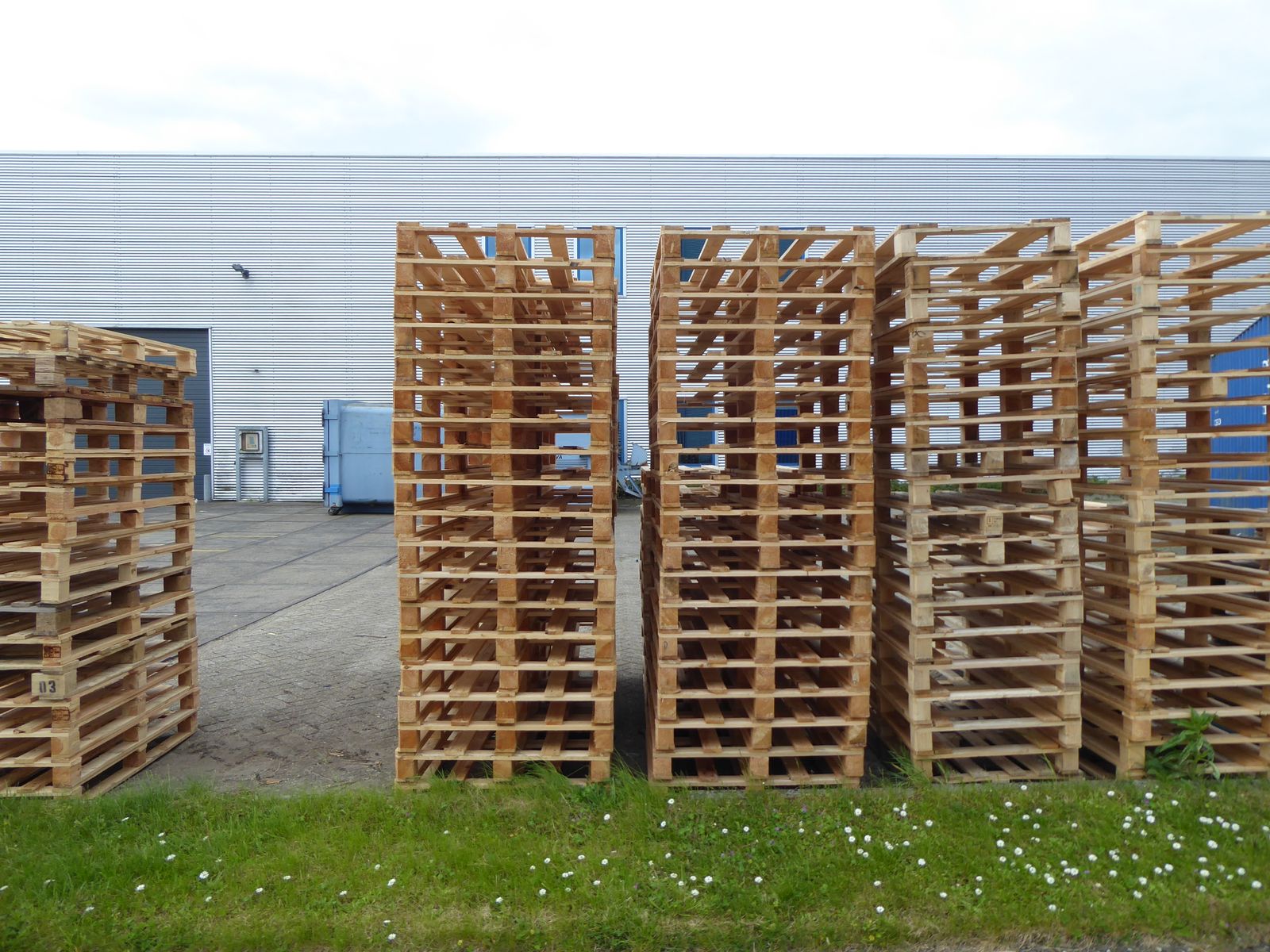
Most commercial pallet buyers already know there are three main options: new, used, and recycled. What is less obvious is how those three actually differ in practice — not just in price, but in consistency, availability, durability, and the types of operations each one serves best.
This guide compares all three side by side so you can make an informed decision based on what your operation actually needs, rather than defaulting to whichever option is cheapest or most familiar.
What You Are Actually Comparing
Before comparing options, it helps to understand what each pallet type is:
- New pallets are built from freshly milled lumber and have never been in service. They are manufactured to specific dimensions and construction standards.
- Used pallets are previously used pallets that have been inspected for condition and usability but have not been repaired or reconditioned.
- Recycled pallets are previously used pallets that have been actively reconditioned — damaged boards replaced, structural connections re-nailed — and then graded by quality, typically as A-grade or B-grade.
The distinction between used and recycled is important and often misunderstood. Used pallets are inspected but not repaired. Recycled pallets are rebuilt and graded. That difference affects consistency, cost, and which applications each type is suited for.
Side-by-Side Comparison
| Factor | New Pallets | Used Pallets | Recycled Pallets |
|---|---|---|---|
| Cost | Highest per unit | Lowest per unit | Mid-range |
| Consistency | Most uniform — every pallet built to the same spec | Most variable — inspected but unrepaired | Moderate — repaired and graded, but from reclaimed stock |
| Appearance | Clean, fresh lumber, no prior wear | Visible wear, cosmetic marks, possible staining | Functional appearance — may show repaired boards or prior use |
| Load reliability | Predictable from first use — built to rated capacity | Depends on prior use and inspection quality | Rebuilt to meet structural standards, then graded |
| Availability | Manufactured to order — short lead time for standard sizes | Depends on current yard inventory | Depends on current inventory of graded stock |
| Best for | Customer-facing shipments, automated systems, export | One-way shipping, temporary staging, budget operations | High-volume warehouse distribution, recurring domestic shipping |
Cost Considerations
Price is where most buyers start, and the differences are significant. Used pallets are the least expensive option — they have already been through at least one shipping cycle and are sold as-is after inspection. Recycled pallets cost more than used because of the labor involved in reconditioning and grading, but they still cost less than new. New pallets carry the highest per-unit cost because they are built from fresh lumber to exact specifications.
But per-unit price is not the full picture. The real cost question is: what does each pallet type cost your operation over time? A used pallet that fails under load and damages product costs more than the price difference between used and new. A recycled pallet that lasts through 20 trips may have a lower per-trip cost than a new pallet replaced after 30 trips, depending on your application.
Used pallets are often 40-60% less expensive than comparable new pallets. For a warehouse using 500 pallets per month, that difference adds up to thousands of dollars saved annually — even before factoring in the lower per-trip cost of recycled pallets that last through multiple cycles.
For high-volume operations that go through pallets quickly, the per-pallet savings of used or recycled stock adds up substantially over a year. For operations where pallet failure is expensive — automated lines, customer-facing shipments, heavy loads — the consistency of new pallets may justify the higher upfront cost.
Consistency and Dimensional Uniformity
New pallets are the clear winner for consistency. Every pallet in a batch is built to the same dimensions, board spacing, and construction standard. That uniformity matters for operations running automated packaging lines, stretch-wrap machines, or racking systems with precise beam spacing. A pallet that varies by half an inch can jam a conveyor or fail to seat properly in rack.
Recycled pallets offer moderate consistency. They are sorted by size and grade, and the reconditioning process brings them closer to original specifications, but they are still rebuilt from reclaimed stock. Variation exists, though it is more controlled than used stock.
Used pallets have the most variation. A supplier sorts them by size and inspects for condition, but they are not repaired or standardized. For operations where dimensional precision is not critical — internal warehouse movement, one-way freight, temporary staging — that variation is acceptable. For automated systems, it is not.
Appearance and Customer-Facing Use
If your pallets are visible to customers, retail partners, or inspectors, appearance matters. New pallets look clean and professional — fresh lumber, no staining, no repaired boards. They are the right choice for retail displays, customer-facing shipments, and any environment where the pallet reflects on your brand.
Recycled pallets may show evidence of repair — replaced boards, re-nailed connections, or minor cosmetic wear. A-grade recycled pallets look closer to new; B-grade pallets show more wear. For many warehouse and distribution applications, appearance is irrelevant, making recycled pallets a practical choice.
Used pallets show the most visible wear: cosmetic marks, color variation, and prior-use staining. They are best suited for applications where no one sees the pallet — backroom storage, internal transfers, one-way freight to facilities that do not return them.
Load Requirements and Application Fit
Matching the pallet type to the load is where many operations get into trouble by choosing on price alone.
When New Pallets Make Sense
- Automated handling systems that require uniform dimensions
- Heavy or concentrated loads that need full rated capacity from the first use — if you need a pallet rated for 2,500 pounds, every new pallet will meet that spec
- Customer-facing shipments where appearance and consistency matter
- Export shipments requiring ISPM-15 heat treatment — new pallets can be heat treated and stamped for compliance
- Food, pharmaceutical, or clean-environment applications where fresh lumber is preferred
- Operations with strict pallet specifications from retail or logistics partners
When Used Pallets Make Sense
- One-way shipping where pallets will not be returned
- Temporary staging and short-term overflow
- Internal warehouse movement and storage where appearance is secondary
- Budget-conscious operations that need volume at the lowest practical cost
- Standard loads under 2,000 pounds where quality used pallets perform reliably
- Construction sites and job-related material handling
When Recycled Pallets Make Sense
- High-volume warehouse distribution with recurring daily pallet demand
- Grocery and retail distribution where A-grade pallets meet cleanliness and load standards
- 3PL operations managing pallet costs across multiple client accounts
- Operations that need more consistency than used pallets provide but want to stay below new-pallet pricing
- Companies with sustainability or green procurement goals
Compare New, Used, and Recycled Pallets in One Call
W W Pallets stocks all three pallet types at our Plant City yard. Call (813) 707-8474 or request a quote with your pallet type, quantity, and delivery location, and we will help you choose the right option for your operation.
Durability and Repair Potential
New pallets offer the longest potential service life because they start with no prior wear. A well-built new pallet can cycle through dozens of trips before needing repair. The exact lifespan depends on load weight, handling conditions, and whether the pallet stays in your facility or ships out.
Recycled pallets have already been through at least one service life and have been rebuilt to return to service. Their remaining lifespan depends on the quality of the reconditioning and the conditions they face in your operation. A-grade recycled pallets, rebuilt with sound lumber and re-nailed connections, can perform reliably for many trips.
Used pallets have the shortest expected remaining lifespan. They are inspected and deemed usable, but they have not been repaired. Their remaining service life depends on how many times they were used previously, how well they were inspected and sorted, the weight and handling conditions they will face, and whether they were stored indoors or exposed to weather. A used pallet may perform fine for a one-way shipment, but it is not the right choice for a high-cycle operation that depends on the same pallets rotating through repeatedly.
Sustainability Considerations
Recycled and used pallets both extend the life of existing wood resources. Recycled pallets, in particular, keep usable wood out of landfills by rebuilding damaged pallets and returning them to service. For operations with sustainability or green procurement goals, recycled pallets provide a documented environmental benefit alongside cost savings.
Used pallets also contribute to waste reduction by keeping inspected pallets in circulation rather than discarding them after a single use. New pallets, while built from fresh lumber, can also be repaired and recycled at the end of their first service life — pallet lifecycle is not limited to a single use.
Standard 48x40 GMA Pallets
The 48x40 GMA pallet is the most common footprint across all three categories. Most new pallets are manufactured to 48x40 GMA specifications, and most used and recycled inventory is built around this size because it is what the supply chain demands.
If your operation uses 48x40 pallets, all three options are typically available. The choice comes down to condition, consistency, and cost — not size. For a deeper look at why 48x40 became the industry standard and what GMA-style construction means, see our guide to 48x40 pallets for Florida warehouses.
When Custom Pallets Are the Better Choice
Sometimes none of the three standard options — new, used, or recycled — is the right answer because your operation needs a non-standard size or configuration. Custom pallets built to your exact specifications are the right choice when your products have unusual dimensions, concentrated heavy loads, or specific handling requirements that a standard 48x40 pallet cannot address.
Many operations use a combination — standard 48x40 pallets for general freight and custom pallets for specialized products. If your operation has both standard and non-standard needs, work with a supplier that can provide all of the above rather than forcing everything onto a pallet that does not fit.
Export and Heat-Treated Pallet Considerations
If your operation ships internationally, ISPM-15 compliance is a requirement, not an option. ISPM-15 is the international standard for wood packaging materials, and it requires pallets to be heat-treated and stamped with the official compliance mark before they enter export channels.
New pallets can be heat-treated and stamped for ISPM-15 compliance. Used and recycled pallets are generally not recommended for export unless they carry a valid, verifiable ISPM-15 stamp. If your operation handles both domestic and international freight, your pallet plan should include heat-treated pallets as a separate category — ordered specifically for export loads, not mixed into domestic inventory.
Using More Than One Pallet Type
Many operations benefit from using more than one pallet type rather than standardizing on a single option. A common approach:
- New pallets for customer-facing shipments, automated lines, and export orders
- Recycled pallets for high-volume domestic distribution and recurring warehouse movement
- Used pallets for one-way shipping, temporary staging, and internal transfers
This strategy matches each pallet type to the application where it performs best, optimizing both cost and quality. The key is working with a supplier that offers all three options so you are not forced to compromise.
If you are also thinking about how many pallets of each type you need to keep on hand, see our guide to planning pallet inventory for your operation.
Supplier Reliability and Consistent Specifications
Regardless of which pallet type you choose, supplier reliability is the factor that determines whether your plan works in practice. A supplier that delivers consistent specifications, on time, in the right quantity, is more valuable than the cheapest source that delivers inconsistent pallets late.
When evaluating a pallet supplier, ask:
- Can they provide new, used, and recycled pallets from the same yard?
- Do they inspect and grade their used and recycled inventory?
- Can they deliver on a recurring schedule — weekly, biweekly, or custom?
- Do they deliver on their own trucks or broker freight?
- Can they scale volume during peak periods without extending lead times?
- Can they provide heat-treated pallets for export when needed?
A supplier that can answer these questions clearly and back them up with consistent delivery is a partner in your operation. One that cannot is a recurring source of risk.
Choosing the Right Pallet Type for Your Operation
There is no single right answer for every operation. The best choice depends on your products, your volume, your handling systems, your budget, and your customer expectations. For most commercial operations, a mix of new, used, and recycled pallets — each matched to the right application — delivers the best balance of cost, performance, and reliability.
For businesses in Plant City, Tampa, Lakeland, and across Central Florida, W W Pallets supplies all three pallet types from a single yard, with delivery on our own trucks. Call (813) 707-8474 or request a quote online with your pallet type, quantity, and delivery location, and we will help you choose the right option for your operation.